
“In the grim darkness of the far future, there is only war.”
There may be no universe summed up better in one sentence than Warhammer 40,000. A universe in the distant future engulfed in almost endless war and carnage as multiple entities vie for domination across the stars, though what that domination looks like depends on which entity it is.
For humanity, or the Imperium of Man, it is about spreading the word and power of the God-Emperor across the stars and burning out all heretics, non-believers, and filthy xenos until only the Imperium remains. They will achieve this through their various military wings such as the overwhelming firepower of the Imperial Guard, the dogmatic warriors of the Sisters of Battle, or one of the thousand chapters of Space Marines to tackle the most dangerous and important missions for the Imperium.
The Tyranids, by comparison, seek domination through simple digestion. These insectoid aliens exist simply to consume bio-mass on a galactic scale, evolve, and keep consuming until all is one with the Tyranid Swarm and its Hive Mind.
Orks just don’t know what domination is or even how to spell it. All they care about is going to fight a worthwhile WAAAHHH and a good crumpin’.

Those are just three of the many powers locked in never-ending combat with each other across the galaxy. A universe where to be a human is to be among untold trillions living a life a hard labor, crime, awaiting conscription to the Imperial Guard, becoming a Space Marine candidate, or a brutal death at the hands of one of the billions of monstrosities and destructive machines turning planets into graveyards.
It is a universe where there is no true hero to rally behind. Whichever force wins out, the galaxy will likely be worse for it.
And this is the universe that has grown to become a worldwide phenomenon since the tabletop game first hit store shelves in 1987.
The tabletop miniatures war game from Games Workshop has already carved out a sizeable fanbase for itself between the various sub-hobbies for the miniatures game and an expansive narrative universe told through various mediums already across the tabletop game, video games, books, and more.
Despite all this success, it still hasn’t been widely known across mainstream entertainment until the last few years. This was largely on the back of the long-awaited game Warhammer 40,000: Space Marine 2, various animated shorts including one episode in Amazon’s video game-inspired series Secret Level, and Henry Cavill spearheading efforts with Amazon to adapt Warhammer 40,000 to live action.
Of all those, though, Secret Level’s Warhammer 40,000 episode was hailed as one of the best episodes of the series. Longtime fans also applauded the episode for being able to deliver an accurate representation of the universe to more dedicated fans while also introducing it in a way that is palatable to anyone discovering it.
It can be a lot for anyone to take in it at first due to the sheer contrast of styles among the universe’s central powers, alone. The Imperium has an overall Gothic aesthetic style to it, the Tau Empire draws more inspiration from mecha anime and manga such as Gundam, and the force of Chaos are generally some form of cosmic horror. Various sub-factions take this further, such as the original Space Marine Legions all being inspired by various human cultures such as Germanic, Mongolian, and Roman among others.
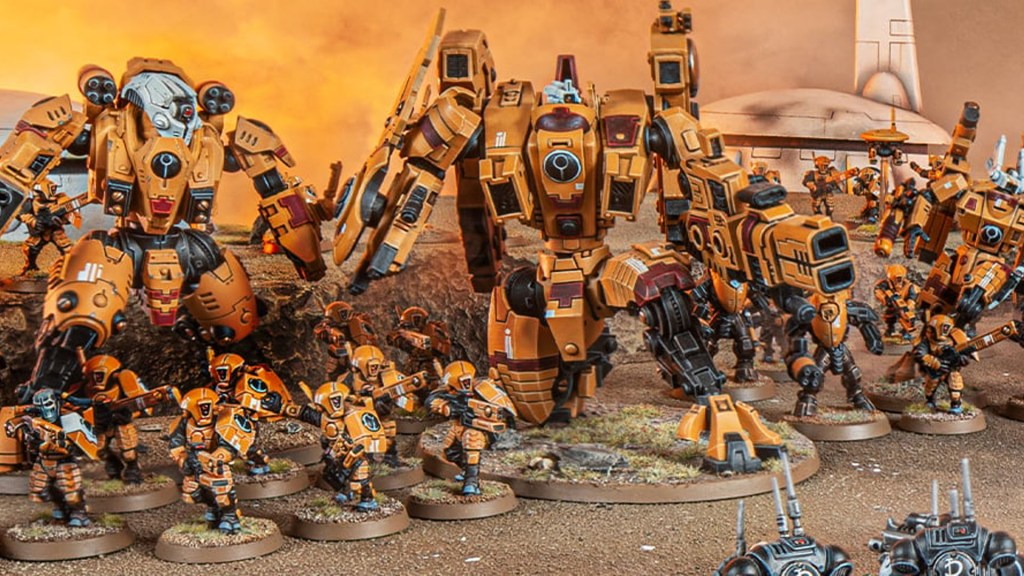
The rabbit hole only gets deeper as there between learning what else makes the races and their various sub-factions unique like their abilities and goals, the characters that perpetuate these groups, the various conflicts taking place, and much more.
On top of this, the Imperium’s tracking of history can be spotty at the best of times and outright wrong or completely non-existent at the worst. Certain major narrative events have established dates to help provide some sense of a timeline, but when and where various other events take place in-between those is another story.
Games Workshop has done this intentionally to avoid bogging down the universe too much in a dedicated timeline and provide flexibility when crafting new stories and adaptations. It could also be the key to adapting Warhammer 40,000 to live action going forward.
An issue the Marvel Cinematic Universe, Star Wars, or any of the various DC Cinematic Universe iterations have all run in to is maintaining an ever-growing canon across various mediums and ensuring there are no contradictions or issues.
Warhammer 40,000 doesn’t have this problem nearly as bad. Anytime sometime comes up in a new game, book, or short that contradicts an older piece of lore, Games Workshop may address it but is just as likely to leave it be for a time so as to get fans talking.
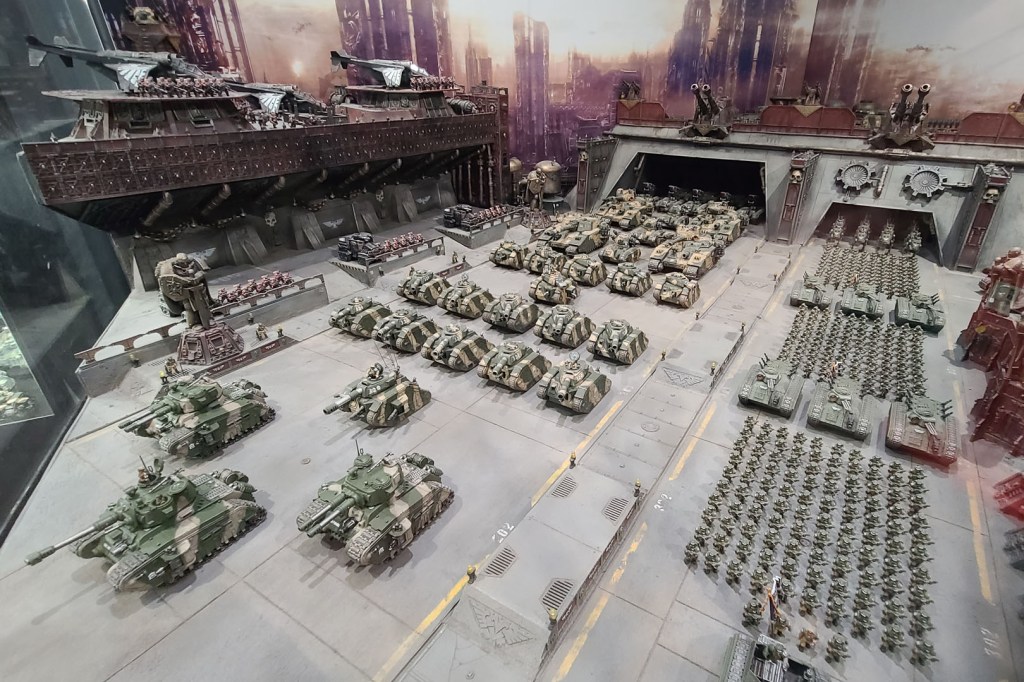
It allows Games Workshop and Amazon and whoever else Games Workshop partners the freedom to, effectively, set whatever new project they are working during general periods versus a very specific period. It also grants them the freedom to adapt Warhammer 40,000 to a variety of genres ranging from horror to war, political thrillers and spy duels and many more.
Warhammer 40,000 grants so much freedom for storytelling that Games Workshop can keep adapting the universe because if something is a disappointment, they can just ignore it and move on. If other things like video games and books don’t get bogged down in the nitty-gritty of Warhammer 40,000 expansive lore, shows and films won’t, either, save for anything directly related to said shows and films.
While audiences still have a ways to wait for Henry Cavill’s series to premiere, if all goes right it could be the start of a long and prosperous run in live action for Warhammer 40,000.

 Minimum Wage Nerd